
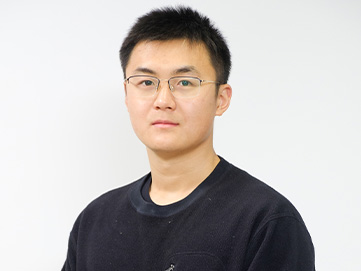
—Why did you choose to pursue platform studies?
Some thirty to forty years ago, way before I entered university, breeding was based on using human experience to improve crops. Later, 10 to 20 years ago, DNA markers were used to improve crops and food. However, since then, no new approaches have emerged. Various fields, such as automobiles and buildings, are using informatics knowledge and big data to help people. That said, there is still no such platform in breeding, so I aim to create just that.
—What research themes are you currently working on?
We are researching platforms for designing and improving new crops. While humanity is facing extensive climate change, there is a lack of clear goals for breeding. Conventional breeding has focused on goals such as how to increase the yield of wheat. It is said that it takes ten years to breed one variety, but given the current accelerating rate of climate change, we cannot catch up with the change unless we look further ahead than the current environment. It is essential to design future crops by considering what varieties will be in demand 10 to 20 years from now and how to cultivate them, in combination with climate change projections. This is the topic of my research.
—What have you gained through the School of Platforms program?
I attended a series of monthly seminars and even underwent interdisciplinary exams. At present, I consider platforms from a broader biological perspective, not only from the perspective of breeding. It is stimulating to be given insights into what platforms should be like from the perspective of other departments. (Although I myself am enrolled in Agricultural Science) Professor Kashima of Informatics is providing support in acquiring the techniques.
—What is the platform to you (ideal situations, desirable future, etc.)?
As a student of plant breeding, I would like to see a platform where the varieties to be bred are listed. Even if the goal is to increase yield, quality is also essential for food production. At present, it is necessary to visit farmers or search the Internet to find out what traits are desired, but with this platform, I hope to create a place where information can be gathered and become a big platform that can serve as a basis for discussion and reference for deciding on such traits.
—If the goal is to improve the world just a little from where it stands today, what do you think is needed, or what would you like to do?
It is said that the world will be unable to meet the food demands of hundreds of millions of people in the coming decades, especially in Africa and other regions. In preparation for climate change and other aspects of humanity’s future, I hope to eliminate poverty in society by improving crops such as wheat, so that their yield will increase even in areas with limited rainfall. I look forward to creating future breeds in the next 10 to 20 years and hope to make them adaptable to the further growth of the earth’s population in the future.
back to Interview