
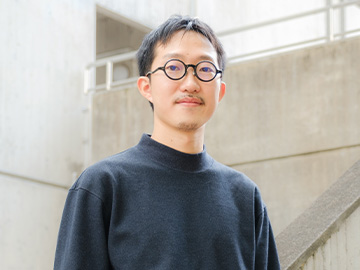
—Why did you choose to pursue platform studies?
When advancing theoretical research, there will inevitably be occasions where the distance with society appears to expand, prompting anxiety. Platform studies is an academic sector that applies various types of research to the real world in moving to expand those fields. I thought that, by coming into contact with and gaining inspiration from numerous different application examples, I would be able to scope out routes for my own theories to be put into practice in society. In addition to the interest in such platform studies themselves, I was also attracted by the ability to obtain economic assistance, and grateful for the expanded options for such financial support during my studies.
—What research themes are you currently working on?
I am advancing research into type systems capable of safeguarding the security of programming languages. More specifically, this involves research of metaprogramming functions at the Igarashi-Suenaga Lab here at Kyoto University, which continues to generate progress in this field. Metaprogramming, the programming function for actual programming languages, is an extremely powerful tool that has become indispensable for the languages used today. On the other hand, however, it also contains certain black magic-like aspects prone to generating troublesome bugs. My research involves designing type systems to support metaprogramming, in order to prevent the generation of such bugs and support secure metaprogramming.
—What have you gained through the School of Platforms program?
At a special event as part of the Seminar Series on Perspectives in Platform Studies, I benefitted from the opportunity to hear a lecture by Yukihiro Matsumoto, creator of the Ruby programming language. I was inspired by his words concerning the design and how to expand the use of programming languages. Lectures and seminars enable us to tap into the opinions of those in other fields, with the emergence of shared challenges from such experiences serving as an area of keen interest. Building sustainable platforms requires creating mechanisms, while making platforms easier to use comprises a worthy challenge for information communications technology. In that regard, the opportunity to listen to the experiences of Professor Hiroshi Harada when he had actually participated in the formulation of international standards was also a source of precious knowledge.
—What is the platform to you (ideal situations, desirable future, etc.)?
From the time that I applied to the School of Platforms, it was my view that metaprogramming offers the potential to serve as an elemental technology in support of platform building. This is because in order to create data-intensive platforms, programs are needed to conduct exchanges with databases. While metaprogramming is often used in such functions at the present time as well, it is necessary to have programs offering greater security and less prone to bugs going forward. Database is the specialty field of Professor Keishi Tajima, my vice-supervisor. In addition to general data-intensive platforms, I also want to explore the types of language crucial in building decentralized platforms utilizing the Internet of Things. I am confident that needs comprising the desire for such functions will provide inroads for initiating such research.
—If the goal is to improve the world just a little from where it stands today, what do you think is needed, or what would you like to do?
Platform building may also be described as the creation of infrastructure. The benefits of developing infrastructure are long term in nature, with their importance prone to be underrated at times when there is no leeway for such efforts in the society. It is for this very reason that we need to understand the aspects of investment in infrastructure throughout society at large, take steady steps in that direction, and have someone rise to the challenge. In my view, theoretical research may be considered the infrastructure for the academic world. As such, I am also pursuing research in hopes that I can contribute to such fruitful infrastructure development.
back to Interview